Ivy is one of the most misunderstood plants around. Love it or loathe it, most gardens I visit have masses the stuff. If you make it your friend, it could turn out to be a blessing in disguise.
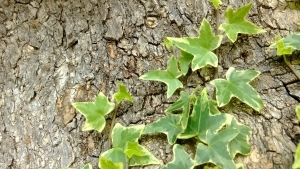 Ivies are evergreen, climbing and trailing plants suitable for growing up walls and fences, or used as ground cover. Choose one of the all green leafed cultivars, and they will thrive in those hostile areas such as deep shade where other plants flatly refuse to grow.
What’s more, if you would like some leaf colour and pattern interest, you’ll be spoilt for choice –green/deep red, green/white, green/bright yellow, and so on. And that’s before you start looking at the size and shape of the leaf itself.
With such a long string of attributes, why oh why is the most frequent question about ivy – how do I get rid of it?
OK, so when you plant it, it remains fairly well-behaved for the first year, but after that it will romp away, clinging, climbing and generally behaving like an unruly teenager. I use that word ‘teenager’ on purpose, as it is the hook on which I hang my revealing story on how to handle a seemingly out of control plant.
Heavens, I’m now beginning to sound like a counselor!
There can be two stages of ivy on the one plant – juvenile and adult growth. The juvenile leaf, for the most part, will be triangular and lobed in shape.
 The adult form is where the plant ceases to climb, and pretends to be a tree.
The leaf shape is the same colour, but is a more oval-ish shape. It also produces yellowish green flowers (great for insects), which then develop into berries (great for birds).
Keep ivy in check and it’ll be of great benefit to your garden.
The juvenile growth produces its own adventitious roots to stick onto the wall or fence, so you don’t have to provide it with trellis or other support.
The thug behavior begins when the plant stems wander off the wall. Check it at this stage, and prune off this wayward growth.
When the plant moves into adulthood, it becomes a real boon but you do not have to put up with huge long stems to enjoy the flowers. If you cut an adult stem almost back to the point where the adult growth starts, it will re-sprout its adult form. You will have a screen of wonderful flowers and berries on stems that are less than 5cm (2in) long.
When it’s done to perfection, this is truly a wonderful sight. Put up with the unruly teenage years, and the adult will reward you all year round and for years to come. Now where have I heard that before?
Valerie McBride Munro is a qualified horticulturist. As Auntie Planty, she offers gardening master classes in your own garden.
© 2009 Valerie McBride-Munro


Leave a Reply